Homogeneity tests on mixing installations
In the world of animal feed, homogeneity tests on mixing installations play an important role. They are essential to ensure the safety, quality and consistency of animal feed. They also help producers comply with regulations and standards.

Pascal Brysse
Why are these tests so important?
- They contribute to food safety by ensuring an even distribution of nutrients, thereby reducing the risk of health problems in animals.
- They play a role in quality control and maintaining consistent performance of animal feed.
In this blog, we examine the obligations regarding homogeneity tests, the methods for carrying them out, and how the results should be assessed. The aim is to gain a better understanding of this important aspect within the animal feed industry.
Who do homogeneity tests apply to?
Homogeneity tests are a legal obligation under European Regulation 183/2005 (Article 5 + Annex II, Premises and equipment (3.b)). This applies to all companies that mix feed of any kind, except for primary producers who make compound feed themselves for their own business, as long as they do not use additives (with the exception of silage additives) or premixtures, and do not use veterinary medicines or intermediate products as defined in Regulation (EU) 2019/4.
It is stated that all equipment used for mixing animal feed must be capable of achieving homogeneous mixtures. The company must be able to demonstrate the effectiveness of the mixing equipment.
By default, homogeneity tests must be carried out at least once every four years. A test must also be carried out when the installation is put into service or when technical adjustments are made to it. A test is specific to one installation. A company with multiple mixing installations must therefore check the homogeneity of each mixing unit separately.
What about medicated feed?
EU Regulation 2019/4 requires regular self-checks and stability tests for homogeneity, limitation of cross-contamination of active substances in non-target feed*, and minimum shelf life of medicated animal feed and intermediate products, as set out in the regulations.
The Royal Decree of 21 February 2006 requires regular checks of the active substance content, homogeneity and stability of medicated feed. These checks must be carried out for every medicated premixture used, per 100 tonnes of medicated feed produced, or at least every 6 months, carried out at the establishment or by an accredited laboratory of the Federal Agency for the Safety of the Food Chain.
*non-target feed: animal feed, whether medicated or not, that is not intended to contain a specific active substance.
How is a homogeneity test carried out?
There are various methodologies for carrying out homogeneity tests. In this blog, we explain the sampling methodology in detail. Where possible, it is best to combine this with carryover tests, which are not mandatory in every company.
Sampling methodology
The homogeneity study can be carried out at various points in the installation.
- When samples are collected directly after the mixer, a good picture is obtained of how the mixer is performing. If, on the other hand, the samples are collected at other points in the installation (for example after the mixer), homogeneity will generally be lower. This is because both demixing and carryover then play a role. Carryover from a previous feed can indeed affect the result of homogeneity tests if the samples are taken further along the line.
Sampling combined with carryover tests
When carryover tests are carried out, the samples should preferably be taken at the same time. The sample quantity should take into account the type of tracer, which will also be used to determine homogeneity (cobalt carbonate, microtracers or sodium salinomycin). With a "protein-manganese" carryover test method, it is also possible to determine homogeneity based on the manganese content. If the company is ACS G-001 or FCA certified, reference is made here to AT08, where this is explained step by step.
Sampling without carryover tests
At a fixed point in the installation where samples are taken, the throughput time of a batch must be determined. (By default) 10 samples must be taken, throughout the entire throughput time of the batch, at relatively stable intervals.
In the case of consumer packaging, samples can also be taken from the packaging line. In all other cases, the sample quantity must be stable and contain the minimum amount required by the lab to carry out the analysis. You can check the lab's quotation for this or contact the lab directly.
Sampling without carryover tests because they are not required
When no carryover tests are carried out because they are not required, a tracer of choice can be used. For FCA-certified companies, this refers to a trace element added at more than 100 ppm. It is also possible to choose full-spectrum analysis (crude protein, crude fibre, crude ash). The latter is only possible for all-mash mixtures, mixtures of unmodified raw materials, and mixtures of granulates with different properties.
Non-certified company without a carryover obligation
When a company is not certified, and no carryover test needs to be carried out, it is also possible to opt for analysing other components, properties or raw materials. Provided that one of the raw materials differs significantly from the others and is significantly detectable analytically, this difference can be analysed.
Example 1: a fat or oil mixed into a blend where the other raw materials are low in fat.
Example 2: an acidic or basic raw material added to a neutral raw material (pH determination).
Example 3: an ingredient that can be chemically defined, such as calcium carbonate (calcium analysis).
A homogeneous mixture should show little deviation on such analyses. In a heterogeneous mixture, the analytical value will differ noticeably between samples.
How is homogeneity assessed?
Once the (by default) ten analysis results are known, they must be processed. Two methods are used for this.
- Direct method for microtracers
- Indirect method in all other cases
Direct method
The result can only be reliably assessed if there are at least 15 microtracer particles per determination.
We recommend creating a clear spreadsheet and adding it to the file. The following data must be determined.
- Number of microtracer particles per sample
- Average number of microtracer particles across the samples ("X")
- Number of degrees of freedom: number of samples -1 (default: 10-1 is "9")
- Square of the difference between the number of microtracer particles and the average number
- The sum of these squares ("S")
- The Chi-squared value ("X²" is "S" divided by average "X")
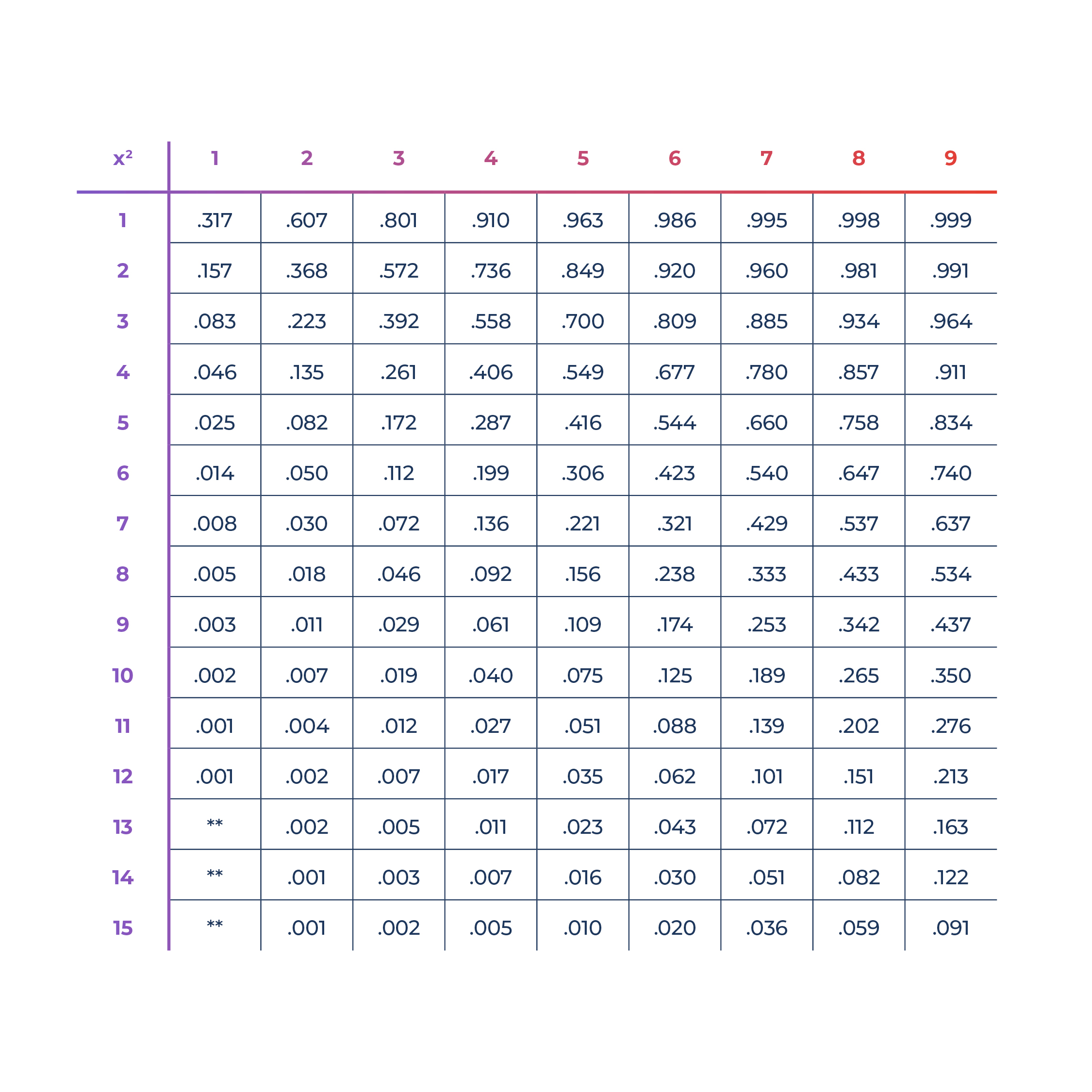
- Probability "p" expressed as "%" (to be determined using the number of degrees of freedom and Chi-squared from a probability table)
- Assessment of the probability in the table below
Example of a probability table.
horizontal: number of degrees of freedom; vertical: Chi-squared values.
Indirect method
To determine the quality of homogeneity using the indirect method, the coefficient of variation must be determined and expressed as a %. Each analysis value must be significant and therefore not close to the LOQ.
We recommend creating a clear spreadsheet and adding it to the file. When working with multiple parameters (such as in full-spectrum analysis), this calculation must be made for all parameters. The following data must be determined.
1. Analytical value per sample
2. Average number of microtracer particles across the samples ("X")
3. Number of samples -1 ("n-1")
4. Square of the difference between the number of microtracer particles per sample and the average number across all samples. Here is an example:
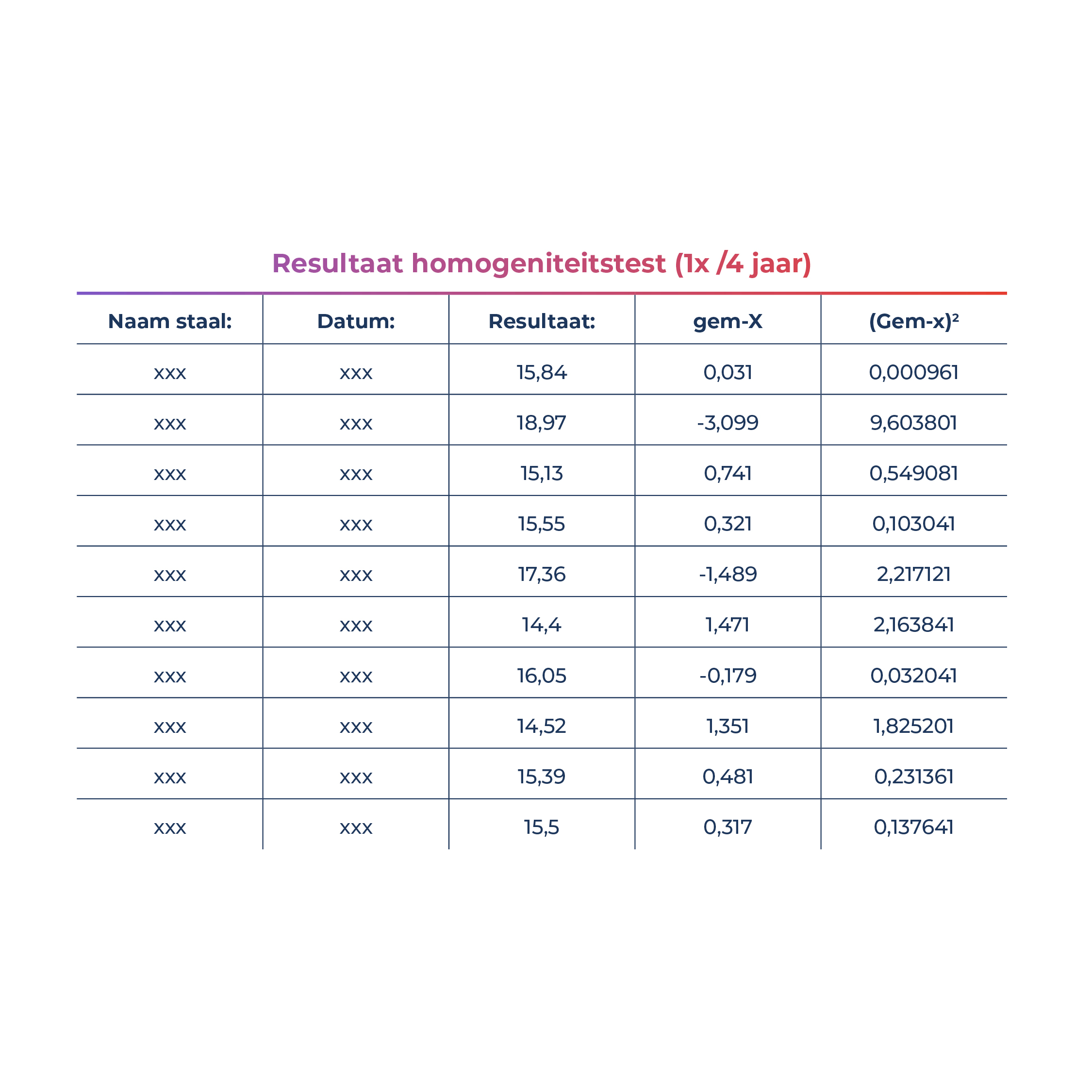
5. Sum of these squares ("S")
6. Standard deviation σ = √(S/n-1)
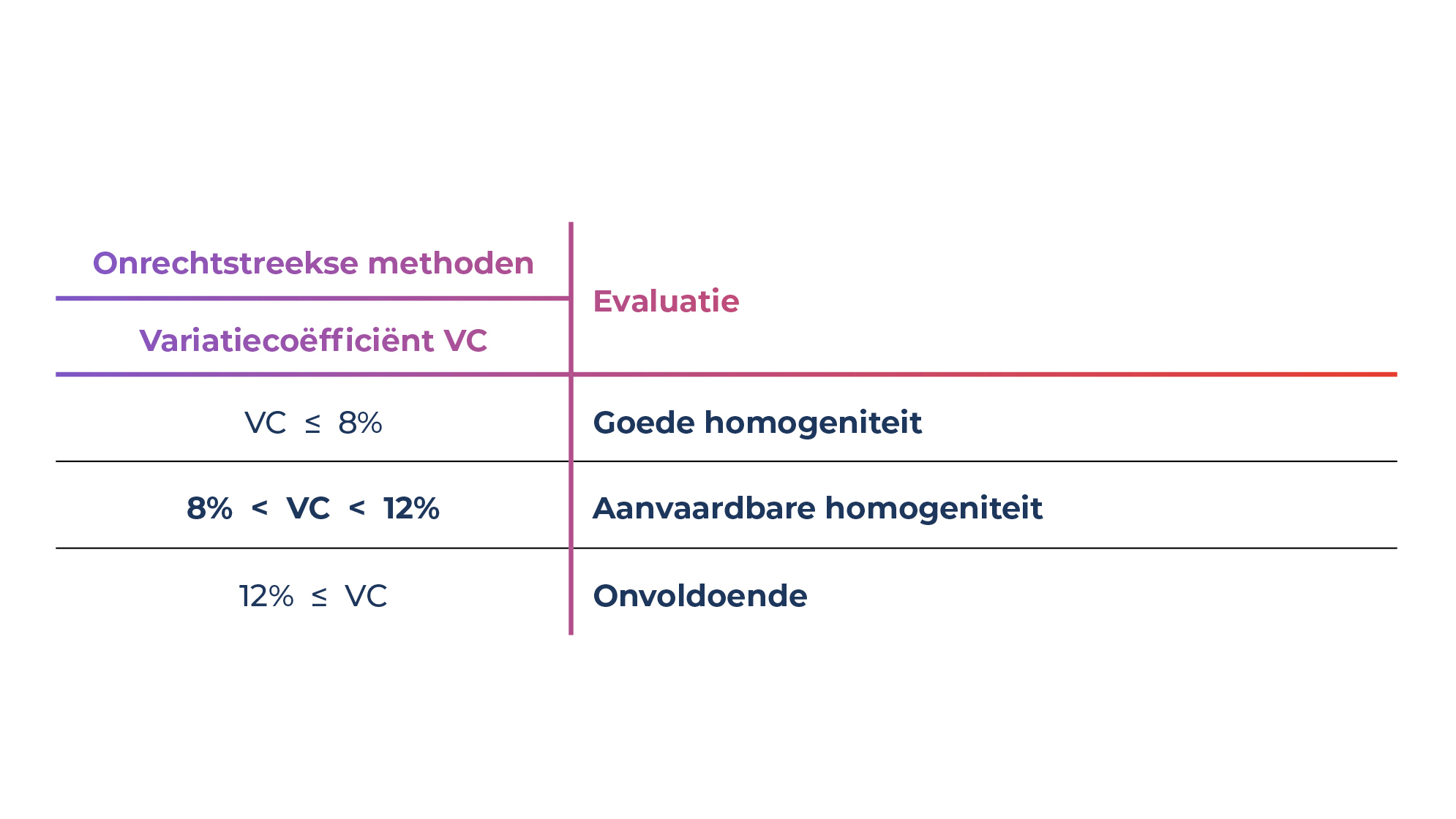
7. Coefficient of variation: CV = σ/X
8. Assessment in the table below:
What needs to happen in the event of deviations?
In the event of deviations, measures must be taken to correct the causes within the installation. Causes can vary from insufficient mixing time, an unsuitable batch size relative to the volume of the installation, to dead zones or defective mixing systems. It may also be that the mixing installation is not suitable for that type of feed. A new test is required after resolving the issues. Due to the adjustment, a new carryover test may also be necessary. An FCA company must also draw up an internal report on this.
How can AMNorman support you?
Do you still have questions after reading this blog about the application of homogeneity tests? Let's meet. Our Normanists are ready to help.